PHP 8.0 → 8.5: A Deep, Practical Guide for Real-World Developers

Kritim Yantra
Dec 24, 2025
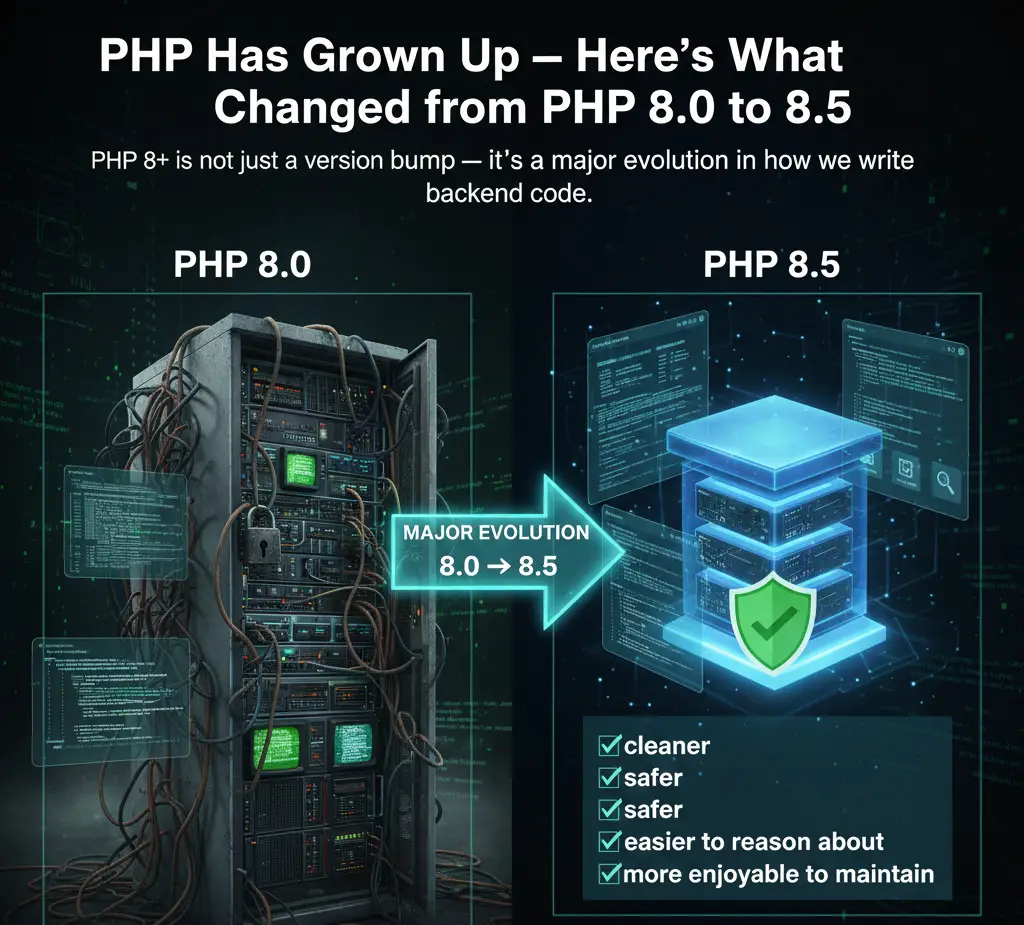
Modern PHP explained with realistic, production-style examples
PHP 8 didn’t just add features — it changed how PHP applications are designed. From cleaner syntax to real immutability, from better typing to dramatically improved debugging, PHP 8.x lets you write code that is easier to read, harder to break, and nicer to maintain.
This article goes version by version, explains what problems each feature solves, and shows realistic examples you’d see in real applications (especially APIs, services, and Laravel-style code).
PHP 8.0 — The Modern PHP Reset
PHP 8.0 is the foundation. Almost everything after it builds on these ideas.
1. Named Arguments (Finally readable function calls)
The real-world problem
Many PHP functions and framework methods have lots of optional parameters. Positional arguments quickly become unreadable.
Mail::send($view, $data, $callback, true);
What does true mean?
PHP 8.0 solution
Mail::send(
    view: 'emails.welcome',
    data: $payload,
    callback: $callback,
    html: true
);
Why this matters in real projects
- You don’t need to check documentation constantly
- Refactoring is safer
- Optional parameters become usable
You’ll see this a lot in framework internals, HTTP clients, and helpers.
2. Union Types (Realistic input handling)
Before PHP 8
APIs often accept multiple input types, but PHP forced you to lie:
function findUser($id) {
    // could be int or string
}
With PHP 8.0
function findUser(int|string $id): User {
    return User::where('id', $id)
        ->orWhere('uuid', $id)
        ->firstOrFail();
}
Why it matters
- Your function contract matches reality
- IDEs and static analyzers finally help
- Fewer runtime surprises
3. Attributes (Framework magic, done properly)
The old way (docblocks)
/**
 * @Route("/users")
 * @Method("GET")
 */
class UserController {}
These were comments — PHP didn’t understand them.
PHP 8.0 attributes
#[Route('/users', methods: ['GET'])]
class UserController {}
Real-world usage
Frameworks now use attributes for:
- Routing
- Validation rules
- Event listeners
- Serialization
- API documentation
They’re faster, safer, and refactorable.
4. Constructor Property Promotion (Clean domain models)
Before PHP 8
class CreateUserDTO {
    public string $email;
    public string $name;

    public function __construct(string $email, string $name) {
        $this->email = $email;
        $this->name = $name;
    }
}
After PHP 8
class CreateUserDTO {
    public function __construct(
        public string $email,
        public string $name
    ) {}
}
Why this is huge
- DTOs become trivial to write
- Encourages better architecture
- Less boilerplate = fewer bugs
This feature single-handedly improved PHP OOP quality.
5. Match Expressions (Business logic without bugs)
Realistic example: mapping statuses
$statusLabel = match ($order->status) {
    OrderStatus::Pending => 'Waiting for payment',
    OrderStatus::Paid => 'Paid',
    OrderStatus::Cancelled => 'Cancelled',
};
Why match beats switch
- No fall-through
- Must handle all cases
- Always returns a value
This is perfect for business rules.
6. Nullsafe Operator (ORM-friendly)
Common ORM pattern
$name = $user?->profile?->address?->city;
Why it matters
- No nested
ifblocks - Cleaner data traversal
- Much safer when dealing with optional relations
You’ll use this daily in real apps.
PHP 8.1 — Domain Modeling & Safety
PHP 8.1 pushed PHP into proper domain-driven design territory.
7. Enums (No more fake constants)
The old way
class OrderStatus {
    const PENDING = 'pending';
    const PAID = 'paid';
}
Anyone could pass "banana" by mistake.
PHP 8.1 enums
enum OrderStatus: string {
    case Pending = 'pending';
    case Paid = 'paid';
    case Cancelled = 'cancelled';
}
Real usage
function markAsPaid(Order $order): void {
    if ($order->status !== OrderStatus::Pending) {
        throw new DomainException('Invalid state');
    }

    $order->status = OrderStatus::Paid;
}
Why enums matter
- Impossible invalid states
- Cleaner domain logic
- Better database mapping
8. Readonly Properties (Accidental mutation killer)
Example: immutable value object
class Money {
    public function __construct(
        public readonly int $amount,
        public readonly string $currency
    ) {}
}
Once created, it cannot be changed.
Why this matters
- Prevents hidden side effects
- Makes reasoning about code easier
- Encourages functional-style design
9. Fibers (Async without pain)
You usually don’t write fibers directly, but frameworks do.
Example idea
- HTTP clients
- Job queues
- Async database drivers
Fibers allow non-blocking PHP without callbacks or promises everywhere.
PHP 8.2 — Immutability & Precision
10. Readonly Classes (Perfect DTOs)
readonly class UserResponse {
    public function __construct(
        public int $id,
        public string $email,
        public string $name
    ) {}
}
Why this matters
- API responses become safe by default
- No accidental overwrites
- Great for CQRS-style apps
11. Standalone true / false / null Types
Example: feature flags
function isFeatureEnabled(): true {
    return true;
}
Why this matters
Mostly for:
- Static analysis
- Framework internals
- Advanced correctness guarantees
PHP 8.3 — Small Features, Big Comfort
12. Typed Class Constants
class Pagination {
    public const int DEFAULT_LIMIT = 25;
}
Why this matters
- Prevents misuse
- Improves IDE hints
- Makes constants safer
13. #[Override] Attribute
class ApiUserRepository extends UserRepository {
    #[Override]
    public function find(int $id): User {}
}
If the parent method signature changes, PHP warns you.
Why this matters
- Safer inheritance
- Better refactoring confidence
PHP 8.4 — Cleaner Everyday Code
14. New Array Helpers (Real-world collections)
$activeUser = array_find(
    $users,
    fn ($user) => $user->isActive()
);
Instead of manual loops:
foreach ($users as $user) {
    if ($user->isActive()) {
        $activeUser = $user;
        break;
    }
}
Why this matters
- Less noise
- Clear intent
- Functional-style coding
PHP 8.5 — Readability & Debugging Heaven
15. Pipe Operator (|>) — Transformations made readable
Realistic example: slug generation
$slug = $title
    |> trim(...)
    |> strtolower(...)
    |> str_replace(' ', '-', ...)
    |> preg_replace('/[^a-z0-9\-]/', '', ...);
Compare to old style
$slug = preg_replace(
    '/[^a-z0-9\-]/',
    '',
    str_replace(
        ' ',
        '-',
        strtolower(trim($title))
    )
);
Why this matters
- Reads top to bottom
- Easier to debug
- Perfect for data pipelines
16. Fatal Error Stack Traces (Massive DX win)
Before PHP 8.5:
- Fatal error
- No stack trace
- Guesswork
Now:
- Full stack trace
- Clear error location
- Faster debugging
This alone saves hours in production incidents.
17. Better CLI Tools
php --ini=diff
Shows only overridden settings.
Why this matters
- Debug environment issues faster
- Less guessing in Docker/CI setups
Final Takeaway: Why PHP 8+ Is Worth It
Modern PHP:
- Encourages better architecture
- Reduces runtime bugs
- Improves developer happiness
- Competes strongly with other backend languages
Recommended adoption path
- Upgrade to 8.0+ immediately
- Use
match, named args, nullsafe operator - Introduce enums and readonly DTOs
- Adopt array helpers and pipe operator
- Lean into immutability and strong typing
Tags
Comments
No comments yet. Be the first to comment!
Please log in to post a comment:
Sign in with GoogleRelated Posts
Laravel 2026: The Future of PHP Development Has Officially Arrived
Laravel 2026: The Future of PHP Development Has Officially Arrived
Kritim Yantra
Laravel for Serious Developers: What Actually Matters
Laravel vs Node.js in 2026 — Which Should You Learn?
Laravel vs Node.js in 2026 — Which Should You Learn?
Kritim Yantra